A consignment of electronics can look straightforward on a packing list, yet a damaged screen, undeclared lithium battery or incorrect commodity code can quickly stop it moving. Knowing how to export electronics safely means managing the product, packaging, freight mode and customs paperwork as one process – before collection is booked.
For UK exporters, the right plan protects valuable stock, reduces avoidable handling delays and gives overseas customers greater confidence in delivery. The details vary between a pallet of consumer devices, industrial control equipment and high-value servers, but the same operational principles apply.
Start with the product and destination requirements
Build an accurate description of every item before requesting a freight quotation. State what the electronics are, their intended use, quantity, country of manufacture, individual and total value, dimensions, weight and whether they are new, used, repaired or returned goods. Vague terms such as “electronic parts” are rarely enough for customs or carriers.
The destination market may require product compliance documents, safety markings, import licences or approvals for radio-frequency equipment. Devices containing Wi-Fi, Bluetooth, GPS, cameras or encryption technology can face additional controls in some countries. Medical, telecommunications and defence-related equipment may also have separate export-control considerations.
Do not assume that compliance in the UK is automatically sufficient overseas. Check the requirements for the importing country early, particularly when supplying a new market. This is also the point to establish the correct commodity code and likely duty and VAT treatment. A suitable HS code supports accurate customs declarations, while a poor classification can lead to delays, reassessments or penalties.
Check whether batteries change the shipment category
Lithium-ion and lithium-metal batteries require particular care. Depending on their type, watt-hour rating, quantity and whether they are packed with equipment, contained in equipment or shipped separately, they may be regulated as dangerous goods.
This affects packing instructions, labels, marks, documentation, carrier acceptance and the freight services available. A laptop with an installed battery may travel under different conditions from a carton of spare power banks. Damaged, recalled or defective batteries can be restricted or refused altogether.
Give your freight coordinator complete battery information, including battery chemistry, watt-hour rating, number of cells or batteries, and safety test documentation where required. Never conceal batteries to secure a lower price or use a service that does not accept them. The cost of a compliant route is far lower than the cost of a stopped shipment, safety incident or rejected consignment.
How to export electronics safely with secure packing
Electronics are vulnerable not only to impacts, but also to vibration, static electricity, moisture, compression and temperature changes. Packaging should match the product’s fragility, value, journey length and number of handling points.
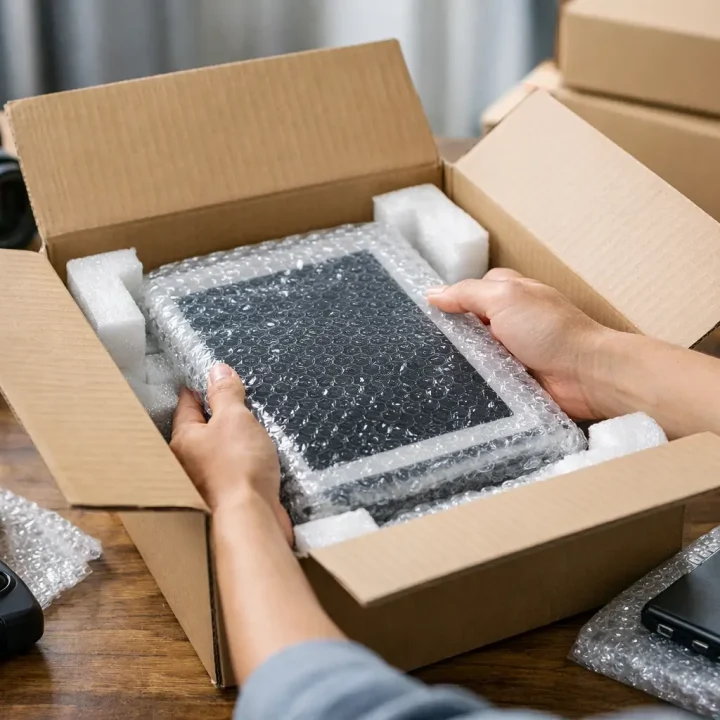
Whenever possible, use the manufacturer’s original packaging inside a strong outer carton. Individual units should be separated so they cannot move or rub together. Anti-static bags are appropriate for sensitive components such as circuit boards, processors and memory modules, while foam inserts or custom moulded protection can prevent movement around more delicate equipment.
For heavier goods, crate construction, palletisation or both may be the safer solution. A server rack, laboratory instrument or industrial machine should be secured to a suitable pallet or skid, protected at vulnerable corners and stretch-wrapped without placing pressure on switches, screens or controls. The load must be stable enough for forklift handling and transport through warehouses, ports and airports.
Moisture protection matters on sea freight and on routes with major temperature variation. Use sealed inner packaging or desiccants where appropriate, particularly for goods travelling in a container over several weeks. For high-value equipment, shock, tilt or moisture indicators can provide useful evidence if a damage claim is needed, although they do not replace proper packing.
Avoid overpacking solely to make a shipment look secure. Excessive volume increases chargeable weight on air freight and can make a pallet unstable. The aim is proportionate protection: enough to prevent predictable damage without adding unnecessary cost or complexity.
Choose a freight mode around risk, time and cost
The safest transport mode is not always the fastest or the cheapest. It depends on the value of the goods, delivery deadline, battery status, destination and packaging standard.
Air freight is often the best option for urgent, high-value and compact electronics. It offers shorter transit times and typically fewer days in the supply chain, although security procedures and dangerous-goods restrictions can be more exacting. Chargeable weight can also make air freight less economical for bulky, lower-value stock.
Sea freight can offer strong cost control for large volumes, full containers and regular replenishment shipments. FCL provides greater control when a consignment fills or substantially occupies a container. LCL is often suitable for smaller quantities, but it involves consolidation and deconsolidation, creating additional handling points. Goods moving by LCL need particularly durable outer packaging.
European road haulage can be efficient for palletised electronics moving within Europe, especially where direct collection and delivery reduce transfers. Rail and multimodal options may suit planned volumes where lead times allow. For critical spares, a courier or dedicated urgent service may be justified, but battery acceptance must still be confirmed before booking.
A practical route plan considers collection, consolidation, export clearance, main carriage, destination customs clearance and final delivery. Milky Way Logistics can coordinate these stages through one point of contact, helping exporters select a route that protects both stock and delivery commitments.
Prepare documents before the goods are collected
Documentation is central to safe exporting because it tells customs authorities, carriers and the receiver exactly what is moving. At minimum, commercial shipments usually need a commercial invoice and packing list, supported by the appropriate export declaration and transport documentation.
The commercial invoice should show the seller and buyer details, clear goods description, commodity code, country of origin, quantities, unit and total values, currency, Incoterm and reason for export. The packing list should identify the number of cartons, pallets or crates, along with their weights and dimensions.
Use descriptions that match the physical goods. If an invoice says “computer accessories” but the consignment contains mobile phones with lithium batteries, customs and carrier checks can expose the discrepancy. Accurate data also helps your customer prepare for destination duty, VAT and clearance requirements.
Agree Incoterms before dispatch. They determine who arranges transport, insurance, export formalities, import clearance and payment of duties and taxes. Choosing an Incoterm simply because it is familiar can create confusion at destination. The right term depends on your customer relationship, commercial leverage and the level of control you need over the movement.
Manage security, insurance and handover control
High-value electronics are attractive to thieves, especially when cartons reveal a recognisable brand or product type. Use discreet outer packaging where possible, restrict product detail on external labels and ensure collection takes place from a controlled location.
Maintain a documented chain of custody. Record serial numbers, take photographs before dispatch, retain packing records and confirm the collection driver’s identity. For palletised or crated cargo, photograph the secured load and its condition before handover. These records support claims handling and help resolve disputes about shortages or damage.
Carrier liability is not the same as cargo insurance. Freight liability can be limited by international conventions and contract terms, often well below the commercial value of electronics. Consider cargo insurance based on the true invoice value, journey and level of cover required. Be clear about exclusions, packing requirements and notification times should an incident occur.
Do not overlook returns and repairs
Electronics sent abroad for repair, demonstration, exhibition or temporary use need planning before departure. Without the correct customs procedure and supporting records, a returning item may be treated as a fresh import and attract unexpected duty or VAT. Serial numbers, values, repair paperwork and export evidence are especially useful for return movements.
Build time into the export plan
The most common safety failure is leaving decisions until the day of collection. Battery checks, export documentation, crating and customs data all need time. A rushed shipment is more likely to be packed poorly, described inaccurately or booked on a service that does not suit the goods.
Request a tailored, no-obligation freight quotation with the product details, collection location, destination, shipment dimensions, values, urgency and battery information. With the right preparation and active freight coordination, your electronics can leave the UK protected, compliant and ready for reliable delivery.