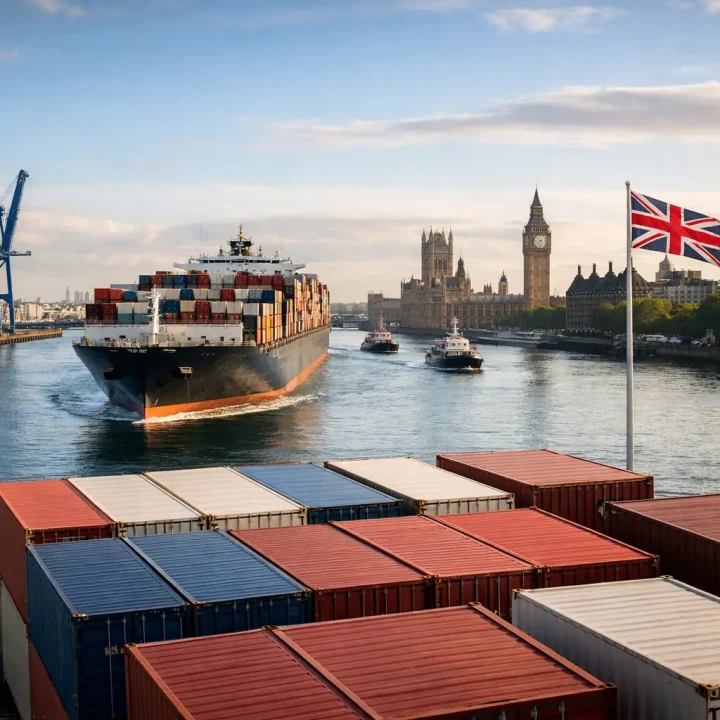
A pallet booked from Birmingham to France, a container leaving Felixstowe for China and an urgent air shipment from Heathrow to the United States all have one customs question in common: who needs export declarations? For most businesses sending commercial goods from Great Britain overseas, an export declaration is required before the goods leave the UK.
This is not simply a formality at the end of the transport process. The declaration gives HMRC and border authorities information about the goods, their value, destination, commodity code and any controls that apply. If the information is missing, late or inaccurate, cargo can be held at the port, airport or border – with storage charges, missed sailings and delivery delays following quickly.
Who needs export declarations from Great Britain?
In broad terms, an export declaration is needed when goods are moved from Great Britain – England, Scotland or Wales – to a destination outside the UK customs territory. This includes goods sent to the EU, the United States, China, the Middle East and most other international markets.
The requirement applies to more than large-scale manufacturers. Export declarations are commonly needed by wholesalers sending regular pallet loads to European customers, online retailers dispatching stock abroad, machinery suppliers moving oversized equipment, and businesses shipping samples, replacement parts or goods for repair.
The party responsible for making sure customs formalities are completed is usually the exporter. In practice, the exporter may appoint a freight forwarder or customs agent to submit the declaration, but the business supplying the information remains responsible for its accuracy. That makes early document checks essential, particularly where goods are controlled, high-value or moving on a tight deadline.
An export declaration may also be needed where there is no sale. A commercial invoice may show a nominal value for customs purposes when goods are being returned, exhibited, repaired or temporarily exported, but customs still needs to understand what is moving and why.
Businesses exporting goods to the EU
Since the UK left the EU customs union, goods travelling from Great Britain to EU member states generally require export customs formalities. A road consignment to Germany, groupage freight to Spain or a courier shipment to Ireland should not be treated as a purely domestic movement.
For European road haulage, timing matters. The declaration information must be available before the vehicle reaches the relevant border process, and the haulier may need the movement reference number before accepting or loading the cargo. A late invoice or an unclear commodity description can hold up an entire shared vehicle, not just one shipment.
Businesses shipping worldwide by air or sea
Air and sea freight exporters need export declarations for most commercial shipments leaving Great Britain. Whether the cargo is one carton moving by air or a full container load travelling by sea, the customs data must match the transport booking and supporting paperwork.
Sea freight often has earlier documentation cut-offs because the carrier requires shipping instructions before the vessel departure. Air freight can move more quickly, but that does not reduce the customs requirement. Urgent cargo still needs the correct commodity code, value, exporter details and any applicable licences before it can be cleared for departure.
Online sellers and occasional exporters
Smaller consignments can create the mistaken impression that no declaration is necessary. The size of a parcel does not automatically decide the customs position. An e-commerce business sending goods from Great Britain to an overseas consumer may need an export declaration, although the exact process can vary by service, destination, value and courier arrangement.
Occasional exporters face the same core requirements as regular shippers. If you are sending commercial goods abroad for the first time, allow time to obtain the correct registrations, prepare suitable paperwork and confirm what the carrier needs before collection.
When export declarations may not be required
There are limited exemptions and alternative procedures, so not every movement follows exactly the same route. Documentary correspondence and some low-value or specific types of goods may be treated differently. Certain postal or courier processes can also involve simplified arrangements.
However, businesses should not assume an exemption applies because a consignment is low value, non-commercial in appearance or travelling to a nearby market. Customs treatment depends on the nature of the goods, the movement, the destination, the transport method and the procedure being used.
Movements involving Northern Ireland need particular care. Northern Ireland operates under different customs arrangements from Great Britain for some movements, and trade with the EU, Great Britain and other destinations can follow different requirements. The right answer depends on where goods start, where they are going, their customs status and whether they are subject to controls.
Temporary movements are another area where assumptions cause problems. Equipment travelling for an exhibition, tools being sent for a project, or goods leaving the UK for repair may need an export declaration and a procedure that supports their return. Without a clear export record, proving that the same goods are returning can become more difficult and may affect duty and VAT treatment.
What information is needed for an export declaration?
Export declarations are submitted electronically through the UK customs system, usually by the exporter or an appointed customs representative. The information should be supported by documents that tell a consistent story about the shipment.
A typical commercial export file includes the seller and buyer details, exporter’s GB EORI number, commodity code, goods description, quantity, weight, customs value, country of origin, destination country and agreed Incoterms. The commercial invoice and packing list should align with this information. Where relevant, the file may also need an export licence, Certificate of Origin, dangerous goods paperwork or evidence for a preferential origin claim.
Descriptions deserve special attention. “Parts”, “samples” or “electronics” are rarely precise enough for customs planning. A useful description explains what the item is, what it is made from and, where relevant, what it is used for. This helps establish the correct commodity code and identify whether restrictions, duties or licensing rules apply.
The Incoterm is equally important. It clarifies the division of transport costs, risk and customs responsibilities between buyer and seller. It does not remove the need for an export declaration, but it affects how the shipment is valued and who is expected to arrange particular parts of the movement.
Export declarations and carrier cut-off times
A declaration completed eventually is not the same as a declaration completed in time. Freight carriers, ports, airlines and hauliers work to operational cut-offs. Missing those cut-offs can mean cargo waits for the next flight, sailing or vehicle departure.
For this reason, export documentation should be prepared as soon as the shipment details are known, not after goods have been packed and collected. The best time to check commodity codes, values and licences is before the booking is confirmed. This is especially true for dangerous goods, dual-use items, controlled products, vehicles and shipments requiring special packing or crating.
Once accepted, the export declaration generates a movement reference number, commonly known as an MRN. Depending on the transport mode and procedure, the carrier or border operator may need this reference before the goods can proceed. On completion of the export process, the relevant evidence can also support VAT records and demonstrate that the goods have left Great Britain.
Common mistakes that delay export clearance
Most export delays are avoidable. They tend to arise where paperwork has been prepared quickly without checking whether every document matches the actual cargo.
The most common issues include vague goods descriptions, incorrect commodity codes, invoice values that do not reflect the shipment, inconsistent weights or package counts, missing EORI details and unclear Incoterms. Businesses also run into difficulty when they overlook destination-country import requirements. A UK export declaration clears the goods for departure; it does not automatically guarantee clearance at destination.
Licensing is another critical point. Goods such as chemicals, military or dual-use items, certain technology, cultural goods, food products and waste can be subject to additional controls. Do not wait until collection day to establish whether a licence or certificate is needed. If there is uncertainty, check the product and route before committing to a delivery date.
Using a freight forwarder for export declarations
A freight forwarder can coordinate the customs declaration alongside collection, carrier booking, transport documents and delivery planning. This is useful when goods are moving by more than one mode, travelling under time pressure or requiring destination clearance and final-mile delivery.
Milky Way Logistics checks the commercial invoice, packing list and shipment details before coordinating export customs formalities. With air freight, sea freight, European road haulage and multimodal options available, the transport plan can be built around the cargo, deadline and budget rather than around a single carrier service.
The exporter should still provide complete and accurate product information. A customs agent can submit the entry, but cannot safely guess the correct commodity code, origin or value. A dedicated review before dispatch is usually far less costly than resolving a border hold after cargo has reached the terminal.
Before booking your next international shipment, confirm the goods description, commodity code, value, Incoterm, destination requirements and required departure date. With those details in place, a tailored freight quotation can include the right transport route and customs support from collection through to delivery.